
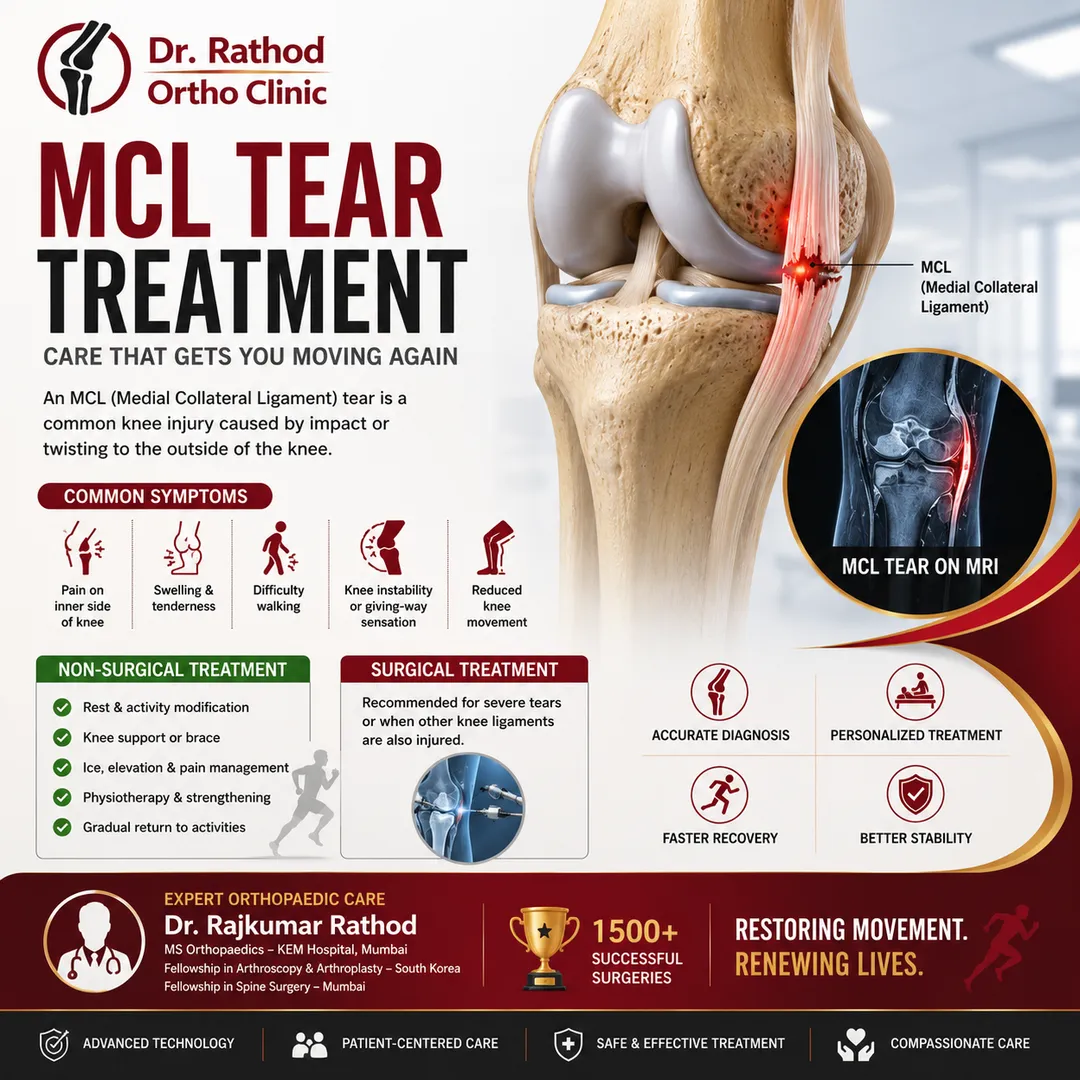
Looking for MCL Tear Treatment in Nashik? Learn about MCL injury symptoms, grades, diagnosis, non-surgical treatment, physiotherapy, surgery, recovery and sports rehabilitation at Dr Rathod Ortho Clinic.
MCL Tear Treatment in Nashik | Medial Collateral Ligament Injury Care
Looking for MCL Tear Treatment in Nashik?
A Medial Collateral Ligament (MCL) tear is a common knee injury, especially among athletes and people involved in activities that involve sudden changes in direction, twisting, or impact to the outside of the knee.
If you are experiencing inner knee pain, swelling, tenderness, or a feeling of instability after an injury, an MCL injury may be one possible cause. Early evaluation by an experienced orthopaedic specialist can help determine the severity of the injury and guide appropriate treatment.
At Dr Rathod Ortho Clinic, patients with ligament injuries receive comprehensive evaluation and individualized treatment based on the type and severity of the MCL injury.
What Is an MCL Tear?
The Medial Collateral Ligament (MCL) is a strong band of tissue located on the inner side of the knee. It connects the thigh bone (femur) to the shin bone (tibia) and helps provide stability to the knee, particularly against forces that push the knee inward.
An MCL tear occurs when the ligament is stretched beyond its normal capacity and becomes partially or completely damaged.
MCL injuries are commonly associated with:
- Sports injuries
- Direct impact to the outer side of the knee
- Sudden twisting movements
- Falls
- Contact sports
- Road or workplace injuries
MCL Tear Grades
MCL injuries are generally classified according to their severity.
Grade 1 MCL Injury
The ligament is stretched and has minor damage. Pain and tenderness may be present, but knee stability is usually maintained.
Grade 2 MCL Injury
There is a partial tear of the ligament. Patients may experience greater pain, swelling, and some degree of knee instability.
Grade 3 MCL Injury
This involves a complete tear of the MCL. Significant instability may occur, and the injury may sometimes be associated with damage to other knee structures.
The appropriate treatment depends on the grade of injury and whether other ligaments or structures are also affected.
Common Symptoms of an MCL Tear
An MCL injury may cause:
- Pain on the inner side of the knee
- Swelling around the knee
- Tenderness along the MCL
- Difficulty walking
- Pain while changing direction
- Knee instability or a feeling that the knee may give way
- Reduced range of motion
- Bruising in some cases
If these symptoms occur after a sports injury, fall, or impact, an orthopaedic evaluation is recommended.
How Is an MCL Tear Diagnosed?
A proper diagnosis usually begins with a detailed clinical examination.
Physical Examination
The knee is assessed for pain, tenderness, movement, stability, and ligament function.
X-Ray
An X-ray may be recommended to assess the bones and rule out an associated fracture or other bony injury.
MRI
An MRI scan can provide detailed information about the MCL and help identify associated injuries involving structures such as the ACL, PCL, meniscus, or cartilage.
This is particularly important because knee injuries can involve more than one structure.
MCL Tear Treatment
Treatment depends on the severity of the tear, knee stability, associated injuries, activity level, and individual patient factors.
1. Non-Surgical Treatment
Many isolated MCL injuries can be managed without surgery.
Treatment may include:
- Rest and activity modification
- Ice application during the early phase
- Appropriate pain management
- Knee bracing when recommended
- Physiotherapy
- Gradual strengthening exercises
- Range-of-motion exercises
- Progressive return to normal activities
The rehabilitation program is generally progressed according to healing and functional recovery.
2. Physiotherapy for MCL Tear
Physiotherapy plays an important role in recovery.
A rehabilitation program may focus on:
Early stage:
Controlling pain and swelling while maintaining appropriate knee movement.
Recovery stage:
Improving knee range of motion and gradually strengthening the muscles around the knee.
Functional stage:
Improving balance, coordination, strength, and knee stability.
Return-to-activity stage:
Gradually preparing the patient for work, sports, or other physical activities.
The rehabilitation plan should be individualized rather than following the same exercises for every patient.
When Is Surgery Considered for an MCL Tear?
Most isolated MCL injuries do not necessarily require surgery. However, surgical treatment may be considered in selected situations, such as:
- Severe or complete ligament injury with persistent instability
- Certain MCL injuries involving ligament displacement
- Associated injuries to other knee ligaments
- Multiligament knee injuries
- Persistent instability despite appropriate non-surgical treatment
- Certain high-grade injuries based on clinical assessment
The decision for surgery requires a detailed examination and appropriate imaging.
MCL Tear With Other Ligament Injuries
An MCL tear can sometimes occur together with other knee ligament injuries.
For example:
- ACL + MCL injury
- PCL + MCL injury
- Multiple ligament injuries
These injuries require careful assessment because treatment and rehabilitation can be different from those used for an isolated MCL tear.
At Dr Rathod Ortho Clinic, comprehensive evaluation helps identify associated ligament and joint injuries and develop an appropriate treatment plan.
MCL Tear Recovery
Recovery time varies according to the severity of the injury and the patient's overall health and rehabilitation progress.
Factors affecting recovery include:
- Grade of MCL injury
- Presence of other ligament injuries
- Muscle strength
- Knee stability
- Rehabilitation adherence
- Type of work or sport
- Overall physical condition
Returning to sports or strenuous activity too early may increase the risk of further injury. A gradual return based on clinical and functional recovery is generally recommended.
Why Choose Dr Rathod Ortho Clinic for MCL Tear Treatment?
Dr Rathod Ortho Clinic provides specialized orthopaedic care for ligament and sports-related knee injuries.
Dr Rajkumar Rathod
- MS Orthopaedics – KEM Hospital, Mumbai
- Fellowship in Arthroscopy & Arthroplasty – South Korea
- Fellowship in Spine Surgery – Mumbai
- 1500+ successful surgeries
The treatment approach focuses on accurate diagnosis, appropriate treatment selection, personalized rehabilitation, and safe return to daily activities or sports.
When Should You See an Orthopaedic Specialist?
Consult an orthopaedic specialist if you have:
- Persistent inner knee pain after an injury
- Significant knee swelling
- Difficulty putting weight on the leg
- Knee instability
- Difficulty walking
- Repeated episodes of the knee giving way
- Symptoms that are not improving with initial care
Early assessment can help identify the extent of the injury and whether other knee structures are involved.
Frequently Asked Questions About MCL Tear
Is an MCL tear serious?
The seriousness depends on the grade of the tear and whether other knee structures are injured. Many isolated MCL injuries respond well to appropriate non-surgical treatment and rehabilitation.
Can an MCL tear heal without surgery?
Many MCL injuries, particularly isolated injuries, can heal with appropriate conservative treatment and rehabilitation. However, severe or complex injuries may require surgical consideration.
How long does an MCL tear take to heal?
Recovery varies depending on the grade of injury and associated damage. Your orthopaedic specialist can provide a more individualized recovery plan after examination.
Can I walk with an MCL tear?
Some people can walk with an MCL injury, while others may experience significant pain or instability. Weight-bearing recommendations depend on the severity of the injury.
Is physiotherapy necessary after an MCL tear?
Rehabilitation is an important part of recovery. It can help restore movement, strength, balance, and knee stability.
Can I return to sports after an MCL tear?
Many patients can return to sports after appropriate healing and rehabilitation. Return should be gradual and based on adequate strength, stability, movement, and functional recovery.
MCL Tear Treatment in Nashik
If you have suffered a knee injury and are experiencing inner knee pain, swelling, or instability, don't ignore the symptoms.
At Dr Rathod Ortho Clinic, we provide comprehensive evaluation and treatment for MCL tears, ACL injuries, PCL injuries, multiligament injuries, sports injuries, and other knee conditions.
📍 Dr Rathod Ortho Clinic
Ishwar Sankul, B-Wing,
Behind Rosamental Plaza,
Gaikwad Mala, Bitco Point,
Nashik Road, Nashik
📞 Appointments: 72761 16146
Take the Right Step Toward Better Knee Function
Get your knee injury evaluated and understand the treatment options suitable for your condition.
Keywords


