If you are searching for Knee Arthritis Treatment in Nashik, you may be experiencing knee pain, stiffness, swelling, difficulty walking, or discomfort while climbing stairs. Knee arthritis is common, especially with increasing age, but persistent symptoms should not simply be considered a normal part of ageing.
The good news is that not every patient with knee arthritis needs surgery. Treatment depends on the severity of cartilage damage, symptoms, activity level, overall health, and response to non-surgical treatment.
At Dr Rathod Ortho Clinic, patients can receive a detailed orthopaedic evaluation to understand the cause of knee pain and the appropriate treatment options.
What Is Knee Arthritis?
Knee arthritis occurs when the structures that help the knee move smoothly become damaged or worn over time. The protective cartilage covering the ends of the bones can gradually deteriorate, resulting in increased friction and changes within the joint.
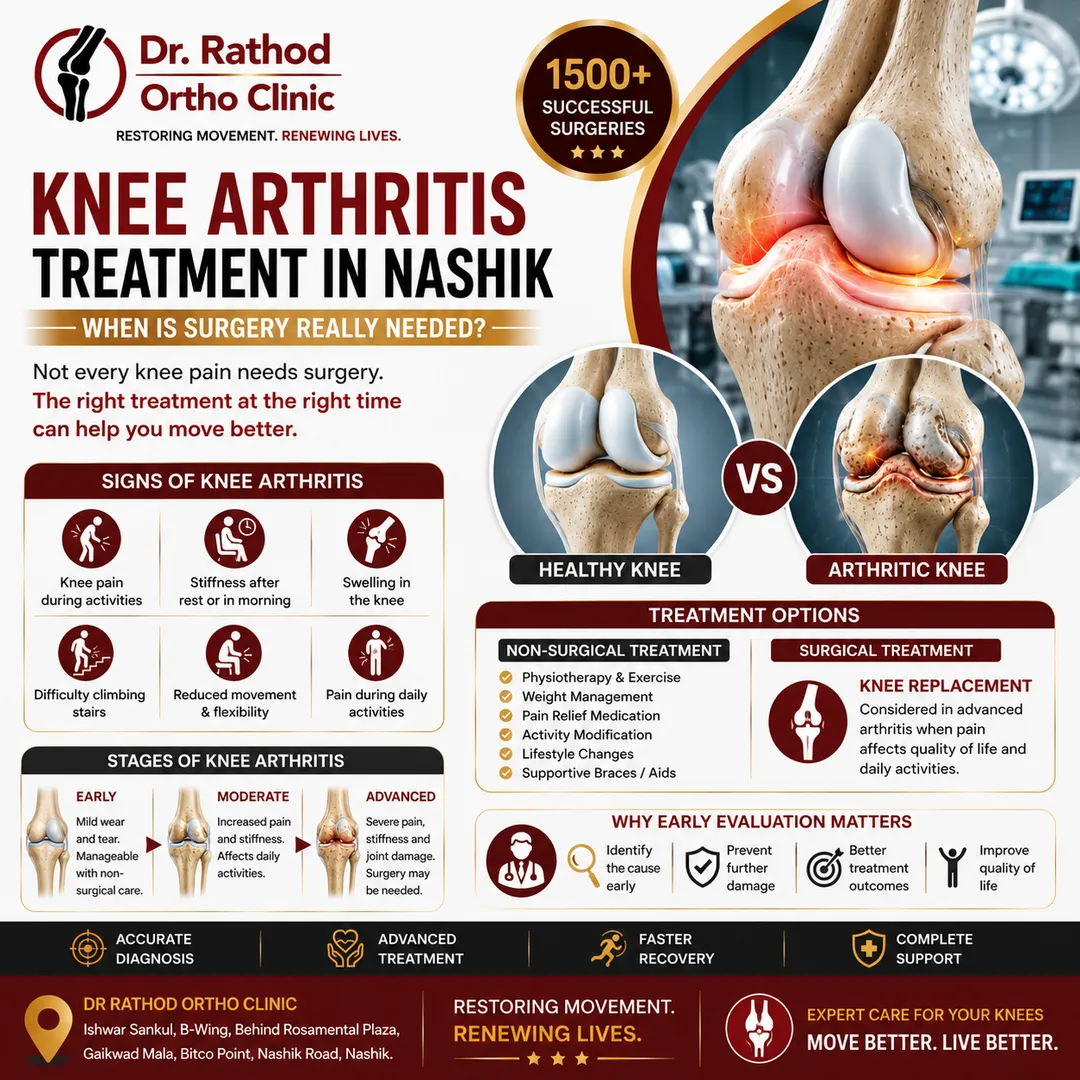
As arthritis progresses, patients may develop:
- Knee pain
- Stiffness
- Swelling
- Reduced movement
- Difficulty walking
- Pain while climbing or descending stairs
- Difficulty getting up from a chair
- Knee pain after prolonged sitting
- Reduced ability to perform daily activities
The severity of symptoms can vary from person to person.
What Causes Knee Arthritis?
Several factors can contribute to knee arthritis.
Age-Related Joint Wear
The risk of osteoarthritis generally increases with age as the joint undergoes cumulative wear and structural changes.
Previous Knee Injury
Previous fractures, ligament injuries, meniscus injuries, or other trauma may increase the risk of developing arthritis later.
Excessive Joint Stress
Certain occupations, repetitive activities, or high-impact activities can place additional stress on the knee.
Weight and Joint Load
Higher body weight can increase the mechanical load placed on the knee joint and may contribute to symptoms.
Genetic and Other Factors
Family history, joint structure, previous surgery, and other individual factors can also influence the development of arthritis.
Early Signs of Knee Arthritis You Should Not Ignore
Recognising symptoms early can encourage timely assessment.
1. Knee Pain
Pain may initially occur during activities such as walking, climbing stairs, squatting, or standing for long periods.
2. Morning or After-Rest Stiffness
The knee may feel stiff after waking up or after sitting for an extended period.
3. Swelling
Some patients experience intermittent swelling around the knee.
4. Difficulty Climbing Stairs
Activities that place greater demand on the knee may become increasingly uncomfortable.
5. Reduced Knee Movement
You may notice difficulty fully bending or straightening the knee.
6. Pain During Everyday Activities
As arthritis progresses, routine activities such as walking, getting up from a chair, or shopping may become difficult.
Understanding the Stages of Knee Arthritis
Knee arthritis can range from relatively mild changes to advanced joint degeneration.
Early Arthritis
Cartilage changes may be limited, and symptoms may occur mainly after prolonged activity.
Treatment often focuses on exercise, strengthening, weight management when appropriate, activity modification, and other non-surgical measures.
Moderate Arthritis
Pain and stiffness may become more frequent, and everyday activities can become increasingly uncomfortable.
A comprehensive treatment plan may combine physiotherapy, exercise, medications when appropriate, lifestyle modifications, and other treatments based on individual assessment.
Advanced Arthritis
There may be significant cartilage loss, joint-space narrowing, deformity, persistent pain, and considerable difficulty with movement.
For selected patients with advanced arthritis and significant functional limitations, knee replacement surgery may be considered.
Knee Arthritis Treatment in Nashik: Does Everyone Need Surgery?
No.
One of the most important things patients should understand is that a diagnosis of knee arthritis does not automatically mean that knee replacement surgery is necessary.
Treatment is generally selected according to:
- Severity of symptoms
- Clinical examination
- Imaging findings
- Effect on daily activities
- Age and activity level
- Overall health
- Response to previous treatments
- Individual treatment goals
An orthopaedic consultation can help determine the most appropriate approach.
Non-Surgical Knee Arthritis Treatment
Many patients can initially be managed without surgery.
Exercise and Physiotherapy
A structured exercise program can help improve muscle strength, flexibility, balance, and overall knee function.
Exercises should be selected according to the patient's condition and performed under appropriate guidance when necessary.
Weight Management
For patients who are overweight, gradual and healthy weight management may reduce stress on the knee and can support overall joint health.
Activity Modification
High-impact activities that aggravate symptoms may need to be modified. Low-impact activities can sometimes be better tolerated.
Medicines
Depending on the patient's condition and medical history, a doctor may recommend medicines to manage pain and inflammation.
Patients should avoid regularly taking pain medicines without medical guidance.
Supportive Measures
Some patients may benefit from appropriate braces, walking aids, or other supportive measures depending on their symptoms and examination.
When Is Knee Replacement Considered?
Knee replacement is generally considered when advanced knee arthritis causes significant symptoms and substantially affects quality of life.
Your orthopaedic surgeon may discuss knee replacement when you have:
- Persistent or severe knee pain
- Significant difficulty walking
- Pain affecting sleep or daily activities
- Severe stiffness or restricted movement
- Difficulty climbing stairs
- Progressive knee deformity
- Advanced joint damage on imaging
- Persistent symptoms despite appropriate non-surgical treatment
The decision should not be based on an X-ray alone. Your symptoms, examination, functional limitations, imaging, and overall health all matter.
What Is Knee Replacement Surgery?
Total Knee Replacement (TKR) is a procedure in which damaged surfaces of the knee joint are replaced with artificial components designed to restore joint function.
The objective of surgery is to:
- Reduce pain
- Improve mobility
- Improve knee function
- Help patients perform daily activities more comfortably
Whether knee replacement is appropriate depends on individual circumstances and should be discussed with an orthopaedic surgeon.
Why Early Orthopaedic Evaluation Matters
Many people continue to ignore knee pain until it starts interfering significantly with their daily lives.
Early evaluation can help:
✔ Identify the cause of knee pain
✔ Determine the severity of arthritis
✔ Understand available treatment options
✔ Start appropriate non-surgical care when suitable
✔ Monitor progression of joint damage
✔ Discuss surgery when it becomes clinically appropriate
Early consultation does not mean immediate surgery. It means understanding your condition and making an informed treatment decision.
Why Choose Dr Rathod Ortho Clinic for Knee Arthritis Treatment in Nashik?
Dr Rathod Ortho Clinic provides comprehensive orthopaedic evaluation and treatment for knee arthritis, knee injuries, ligament problems, sports injuries, and joint replacement.
Dr Rajkumar Rathod
MS Orthopaedics – KEM Hospital, Mumbai
Specialized training includes:
- Fellowship in Arthroscopy & Arthroplasty – South Korea
- Fellowship in Spine Surgery – Mumbai
- 1500+ Successful Surgeries
The treatment approach focuses on understanding the patient's symptoms, evaluating the condition carefully, and recommending treatment according to individual needs.
Knee Conditions Treated
Orthopaedic evaluation at Dr Rathod Ortho Clinic can include conditions such as:
- Knee Arthritis
- Knee Injury
- ACL Tear
- PCL Tear
- MCL Tear
- LCL Tear
- Meniscus Injury
- Sports Injuries
- Multiligament Injuries
- Cartilage Problems
- Knee Joint Degeneration
- Conditions requiring Knee Replacement
Frequently Asked Questions
Is knee arthritis curable?
There is currently no simple treatment that reverses established osteoarthritis completely. However, appropriate treatment can help manage symptoms, maintain function, and improve quality of life.
Does knee arthritis always require knee replacement?
No. Many patients can be managed with non-surgical treatments. Knee replacement may be considered for selected patients with advanced arthritis and significant symptoms.
When should I see a Knee Arthritis Doctor in Nashik?
Consider an orthopaedic consultation if knee pain is persistent, recurrent, worsening, or affecting walking, stairs, sleep, exercise, or everyday activities.
Can exercise help knee arthritis?
Appropriately selected exercise can help improve muscle strength, flexibility, mobility, and physical function. The exercise program should be suitable for your condition.
What happens if I ignore knee arthritis?
Symptoms may progressively interfere with mobility and daily activities. The progression varies between individuals, so an evaluation can help determine the condition and appropriate management.
Is knee replacement suitable for older patients only?
Not necessarily. The decision is based primarily on the severity of joint disease, symptoms, functional limitations, overall health, and individual circumstances rather than age alone.
How do doctors diagnose knee arthritis?
Diagnosis usually involves a medical history and physical examination. X-rays are commonly used to assess structural changes, while MRI or other investigations may be recommended in selected cases.
Knee Pain Treatment in Nashik – Get the Right Evaluation
If your knee pain is affecting your ability to walk, exercise, work, climb stairs, or enjoy everyday activities, don't simply ignore it.
The right treatment may be exercise and physiotherapy, lifestyle modification, medication, or another non-surgical approach. For patients with advanced joint damage and significant symptoms, knee replacement may be discussed.
The important first step is understanding what is causing your knee pain.
Book an Orthopaedic Consultation
Dr Rathod Ortho Clinic
Ishwar Sankul, B-Wing, Behind Rosamental Plaza,
Gaikwad Mala, Bitco Point, Nashik Road, Nashik.
📞 Appointments: 72761 16146
Take the first step towards better knee health.
Consult an orthopaedic specialist and understand your treatment options.
Dr Rathod Ortho Clinic
Restoring Movement. Renewing Lives.
Keywords


