
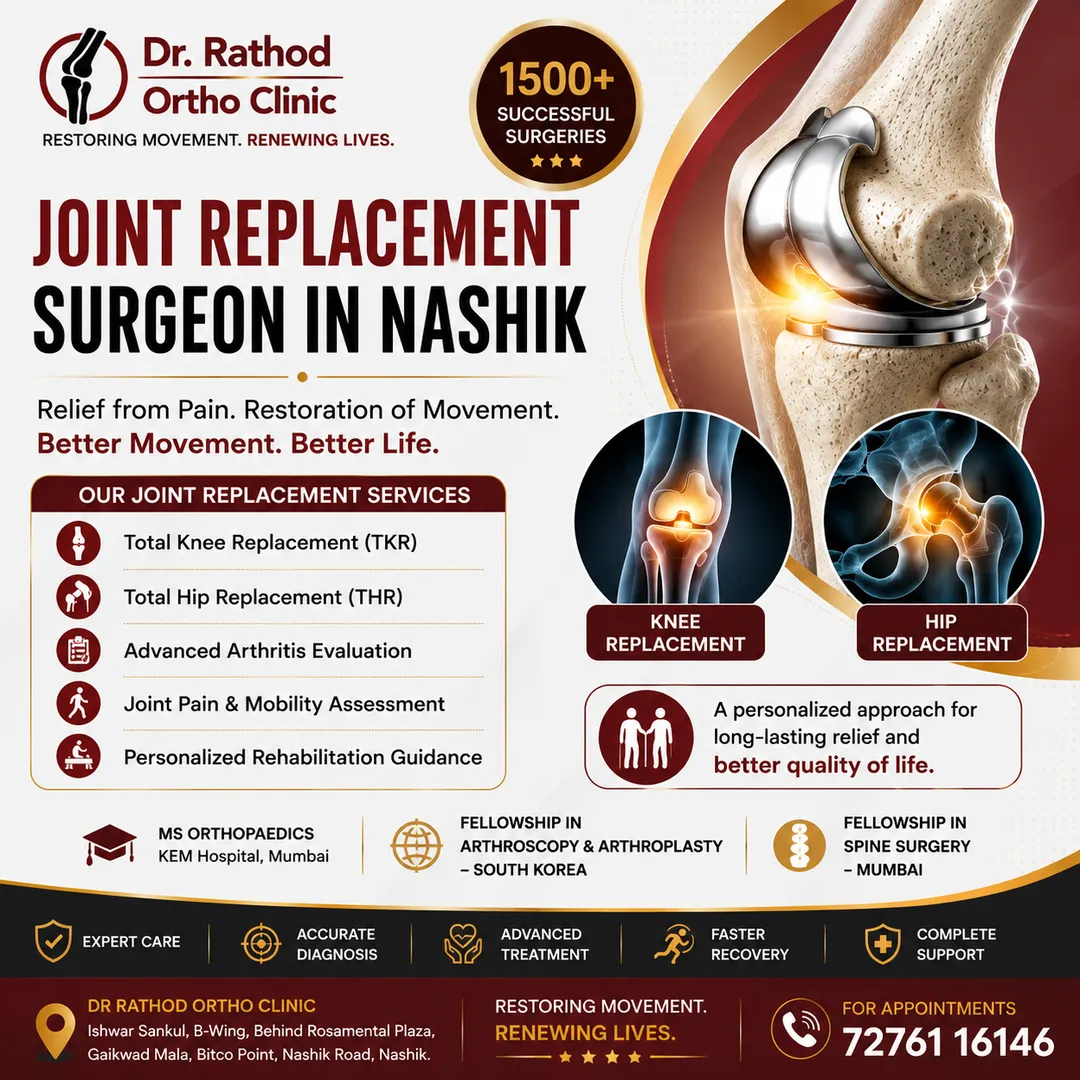
If you are searching for a Joint Replacement Surgeon in Nashik for severe knee or hip pain, arthritis, difficulty walking, or reduced mobility, choosing an experienced orthopaedic specialist is an important decision.
At Dr Rathod Ortho Clinic, joint replacement care focuses on accurate diagnosis, appropriate treatment planning, modern surgical techniques, and personalized rehabilitation. The aim is to help suitable patients improve mobility, reduce pain, and return to everyday activities.
What Is Joint Replacement Surgery?
Joint replacement surgery is a procedure in which damaged portions of a joint are replaced with specially designed artificial components.
It may be considered when a joint has significant damage due to conditions such as:
- Advanced osteoarthritis
- Rheumatoid arthritis
- Severe cartilage damage
- Previous joint injury
- Certain fractures
- Other degenerative joint conditions
The most commonly performed major joint replacements include Total Knee Replacement (TKR) and Total Hip Replacement (THR).
Joint replacement is not required for every patient with joint pain. A specialist evaluates symptoms, examination findings, imaging, activity limitations, and previous treatment before recommending surgery.
When Should You Consider a Joint Replacement Consultation?
Persistent joint pain does not automatically mean you need surgery. However, a consultation with a joint replacement surgeon may be appropriate when you experience:
- Persistent knee or hip pain
- Difficulty walking or standing
- Pain while climbing stairs
- Reduced joint movement
- Stiffness affecting daily activities
- Difficulty sleeping because of joint pain
- Recurrent swelling
- Difficulty performing routine activities
- Limited improvement with appropriate non-surgical treatment
A detailed evaluation can help determine whether continued conservative treatment or joint replacement should be considered.
Knee Replacement Surgery in Nashik
The knee is a weight-bearing joint that can gradually develop cartilage damage and degeneration.
Common symptoms of advanced knee arthritis include:
- Knee pain while walking
- Pain while climbing stairs
- Morning stiffness
- Swelling
- Reduced walking distance
- Difficulty getting up from a chair
- Knee deformity in advanced cases
- Pain affecting daily activities
For selected patients with advanced knee joint damage, Total Knee Replacement may be recommended.
During the procedure, damaged joint surfaces are removed and replaced with artificial components designed to restore joint function.
Hip Replacement Surgery in Nashik
Hip arthritis and other conditions affecting the hip can cause pain in the hip, groin, thigh, or sometimes the knee.
Common symptoms include:
- Hip pain
- Difficulty walking
- Difficulty putting on shoes or socks
- Reduced hip movement
- Pain while standing or climbing stairs
- Difficulty performing everyday activities
For selected patients with significant hip joint damage, Total Hip Replacement may be considered.
The goal is to replace the damaged portions of the hip joint and support improved mobility and function.
Benefits of Joint Replacement Surgery
When joint replacement is appropriate, potential benefits may include:
🦵 Reduced Joint Pain
Replacing severely damaged joint surfaces can help reduce pain caused by advanced joint degeneration.
🚶 Improved Mobility
Patients may experience improved ability to walk and perform everyday movements after appropriate recovery.
🏃 Better Functional Ability
Successful rehabilitation can help patients gradually return to suitable daily activities.
🛌 Improved Quality of Life
Reducing persistent joint pain and improving mobility may make routine activities more manageable.
Important: Recovery and outcomes vary from patient to patient and depend on several factors, including the underlying condition, general health, surgical factors, and rehabilitation.
How Is Joint Replacement Recommended?
A joint replacement surgeon generally considers several factors before recommending surgery.
1. Medical History
The doctor discusses pain, mobility limitations, previous treatments, injuries, and other relevant factors.
2. Physical Examination
The joint is examined for movement, stability, alignment, swelling, and functional limitations.
3. Imaging
X-rays are commonly used to assess joint damage. Additional imaging may be recommended when clinically necessary.
4. Non-Surgical Treatment
Depending on the condition, options such as physiotherapy, activity modification, medications, weight management, walking aids, or other appropriate treatments may be considered.
5. Surgical Planning
If symptoms remain significant and joint damage is advanced, joint replacement may be discussed as a treatment option.
What Happens After Joint Replacement?
Recovery does not end after surgery. Rehabilitation plays an important role in regaining movement and strength.
A recovery program may include:
- Early mobilization as advised
- Physiotherapy
- Range-of-motion exercises
- Muscle strengthening
- Walking progression
- Balance and functional exercises
- Gradual return to daily activities
The recovery timeline varies between individuals. Your surgeon and rehabilitation team can provide guidance based on your specific procedure and progress.
Why Choose Dr Rathod Ortho Clinic for Joint Replacement in Nashik?
Dr Rajkumar Rathod
MS Orthopaedics – KEM Hospital, Mumbai
Dr Rajkumar Rathod has specialized training in joint replacement and arthroscopy, including:
- Fellowship in Arthroscopy & Arthroplasty – South Korea
- Fellowship in Spine Surgery – Mumbai
- 1500+ Successful Surgeries
At Dr Rathod Ortho Clinic, joint replacement treatment is planned according to the patient's symptoms, joint condition, functional requirements, and overall health.
Our Approach
✔ Detailed orthopaedic assessment
✔ Individualized treatment planning
✔ Knee replacement evaluation
✔ Hip replacement evaluation
✔ Modern surgical techniques
✔ Rehabilitation guidance
✔ Patient-focused care
✔ Focus on safe and appropriate treatment
Knee & Hip Joint Replacement Services
Total Knee Replacement
Treatment option for selected patients with advanced knee joint degeneration and persistent symptoms.
Total Hip Replacement
Treatment option for selected patients with severe hip joint damage and significant functional limitations.
Joint Replacement Evaluation
Not every patient with arthritis requires joint replacement. A specialist consultation helps determine the most appropriate treatment pathway.
Joint Replacement vs. Non-Surgical Treatment
Joint replacement is only one part of comprehensive arthritis management.
Depending on the severity of the condition, treatment may include:
Treatment ApproachWhen It May Be ConsideredExercise & PhysiotherapyPain, weakness, stiffness and functional limitationsActivity ModificationActivities aggravating joint symptomsMedicationWhen appropriate for symptom managementWalking AidsWhen additional support is requiredJoint ReplacementSelected patients with advanced joint damage and significant symptoms
The appropriate treatment should be determined after an individual medical assessment.
Frequently Asked Questions
Who is a joint replacement surgeon?
A joint replacement surgeon is an orthopaedic specialist trained to evaluate and surgically treat severe joint conditions, including selected cases requiring knee or hip replacement.
When is knee replacement necessary?
Knee replacement may be considered when there is significant joint damage accompanied by persistent pain and functional limitations, particularly when appropriate non-surgical treatments have not provided adequate relief.
Is hip replacement safe?
Hip replacement is an established orthopaedic procedure. As with any surgery, it has potential risks and benefits. Your surgeon should discuss these with you based on your individual health and condition.
How long does joint replacement recovery take?
Recovery varies depending on the joint replaced, surgical technique, overall health, rehabilitation, and individual progress. Your surgeon can provide a personalized recovery plan.
Can I walk normally after knee replacement?
Many patients work toward improved walking and daily function following knee replacement. Rehabilitation and adherence to postoperative instructions are important parts of recovery.
Does every arthritis patient need joint replacement?
No. Many patients with arthritis can be managed without surgery. Joint replacement is considered when symptoms, joint damage, and functional limitations justify the procedure.
Which joints can be replaced?
The most common major joint replacements include the knee and hip. Other joints may also be considered for replacement in selected circumstances.
Joint Replacement Surgeon in Nashik
If persistent knee or hip pain is affecting your ability to walk, climb stairs, exercise, work, or perform everyday activities, an orthopaedic evaluation can help you understand the condition and available treatment options.
Dr Rathod Ortho Clinic provides specialized orthopaedic care for knee and hip problems, joint replacement evaluation, sports injuries, ligament injuries, arthroscopy, and spine conditions.
📍 Clinic Address
Dr Rathod Ortho Clinic
Ishwar Sankul, B-Wing,
Behind Rosamental Plaza,
Gaikwad Mala, Bitco Point,
Nashik Road, Nashik.
📞 Appointment
72761 16146
Take the First Step Towards Better Mobility
Don't let persistent joint pain limit your everyday life. Schedule an orthopaedic consultation to understand your condition and explore suitable treatment options.
Keywords


